When I was a newbie lawyer just out of law school I worked at a Washington D.C. “BigLaw” firm that concentrated on antitrust law. We represented a client in a criminal antitrust case that involved bid rigging in the highway and airport paving industry. It turns out that bid rigging was rampant in the U.S. southeast, leading to many indictments, guilty pleas and convictions.You can read about it in this 1982 court decision.
What is bid rigging? Typically a state highway or transportation agency would issue a request for bids on a highway paving project. Potential bidders would either ask other contractors not to bid or arrange for them to enter a high bid. Although the winning bidder would have the lowest bid, it would be higher than it might have been had all contractors competed for the job.
The bid rigging case my firm handled was a big one – in fact, when our client eventually pled guilty it paid the largest criminal antitrust penalty in U.S. history to date.
However, before our client pled guilty my firm prepared to defend the case at trial, and the partners gave me a research assignment: find cases that will allow us to argue that bid rigging is not“per se” illegal.
For readers without a background in antitrust law here’s context.
Per Se vs. Rule of Reason
When it comes to anticompetitive conduct that falls under the Sherman Act there are two broad doctrines – “per se” illegality and the “rule of reason.” If the conduct in question falls under the per se rule the act constitutes an unreasonable restraint of trade, and it’s not necessary to consider motive or the economic effects. Under the per se rule an offender can’t justify its conduct by arguing (for example) that it had no anticompetitive effect. The classic example of this is price fixing – if a judge or jury concludes that two or more competitors got together and agreed to raise their prices they are guilty. Period and end of case.
By contrast, under the “rule of reason” a defendant can argue that although it may have engaged in conduct that is potentially anti-competitive, the pro-competitive effects outweighed the anticompetitive effects, and therefore the antitrust laws were not violated.
The judge decides whether a case is governed by the per se rule or the rule of reason. Therefore, antitrust defendants will often argue that the rule of reason should govern their case, and this was the rationale behind my assignment. The BigLaw partners running my case wanted to argue that our client’s bid rigging should be judged under the rule of reason.
It was apparent to the lawyers at my firm (at least the associates working with me) that this was a horizontal price fixing conspiracy, and therefore illegal “per se.” In fact, there were cases that held just that. “A conspiracy to submit collusive, non-competitive, rigged bids is a per se violation of the statute” United States v. Brighton Bldg. & Maintenance Co. (7th Circuit 1979). (link)
No surprise – my research found nothing to the contrary. I spent days in the library reading antitrust cases, hoping to find even a few words that might give us a toehold to argue that our client’s bid-rigging conduct should be judged under the rule of reason. I returned to the partners empty handed.
Is Wage-Fixing Judged Under the Rule of Reason or the Per Se Rule?
What brings this to mind today? – A federal court decision holding that wage-fixing is a per se violation. The case, United States v. Jindal, is the first criminal wage-fixing case brought by the Department of Justice. The federal indictment was returned in December 2020, and the decision that caught my attention was filed in December 2021.
The facts are straightforward – two individuals that owned physical therapy companies agreed to lower the pay rates for physical therapists and PT assistants. They were discovered and the Department of Justice (DOJ) Antitrust Division brought a criminal antitrust case against them.
Although the Jindal case was the first criminal indictment for wage-fixing a second case was filed in March 2021. (United States v. Hee) It’s clear that the labor markets are, for the first time, the focus of the criminal arm of the Antitrust Division.
This comes with plenty of advance notice. In 2016 the DOJ and Federal Trade Commission (FTC) warned that wage-fixing agreements would be prosecuted criminally. President Biden’s July 2021 Executive Order focused on antitrust enforcement in labor markets. In early December the new Assistant Attorney General in charge of the DOJ Antitrust Division noted that many of the economic problems faced by workers have their “roots in collusion and unfair practices in the labor markets,” and warned that the DOJ Antitrust Division will be working closely with the FTC on issues relating to competition in the labor market. (link)
When I read the court’s November 2021 decision in Jindal I saw – shades of my long-ago bid rigging research! – that the defendants argued that wage-fixing is not per se illegal but should be judged under the rule of reason. Likely, a junior associate on the case was sent to the law books to find a precedent that might move wage-fixing from “per se” to “rule of reason.”
No such luck.
Jindal’s Arguments for Rule of Reason Strike Out
First, the defendants argued that wage-fixing is not the same as price-fixing and therefore does not constitute a per se violation. The court rejected this argument, noting that courts have held that a price-fixing conspiracy can pertain to services and price-fixing conspiracies among buyers (in this case employers who buy the services of employees), not just sellers.
Second, the defendants argued that the charges were insufficient because they failed to allege that the defendants had agreed to fix prices paid by consumers. The court rejected this argument, observing that it is well established that the Sherman Act “does not confine its protection to consumers,” but also protects employees.
Third, the defendants argued that courts lacked sufficient experience with wage-fixing to justify classifying it as a per se violation. The court rejected this argument – “The lack of criminal judicial decisions only indicates Defendants’ unlucky status as the first two individuals that the Government has prosecuted for this type of conduct.”
Bottom line: pending appeal and reversal, wage-fixing is a type of price-fixing—and price-fixing is the quintessential per se violation of the Sherman Act. Given the evidence in the case (inculpatory text messages) it looks like Mr. Jindal and his co-defendant should be getting their affairs in order in advance of a prison term.
DOJ Focuses on “No-Poach” Agreements
The broader takeaway for business executives is that while historically the DOJ treated no-poach agreements as civil antitrust violations, criminal prosecutions can lead to felony indictments and prison time. They also need to be aware that the DOJ Antitrust Division is looking beyond just wage-fixing – it has an eye out for “employee allocation agreements” – commonly referred to as “no-poach” or “no-hire” agreements. Under these agreements two or more employers agree that “I won’t hire your employees if you’ll agree you won’t hire mine.” The Antitrust Division is likely to argue that these agreements also are a per se antitrust violation. The DOJ filed an indictment against Surgical Care Affiliates LLC in January 2021 alleging an illegal no-poaching/no-hire agreement (link), and a second no-poach case against aerospace executives as recently as December 16, 2021, while I was writing this post. (link)
Oh, and by the way the associates in the firms defending the no-poach indictments better head for the library and start looking for cases that will persuade the judges that no-poach/no-hire agreements should be judged under the rule of reason.
Nestled within the Biden administration’s recent, sweeping Executive Order on Promoting Competition in the American Economy is a small, rather oblique paragraph that has garnered little attention to date. Appearing as Section 5(d), it urges the Attorney General and the Secretary of Commerce to “consider whether to revise their position on the intersection of the intellectual property and antitrust laws,” in order to “avoid the potential for anticompetitive extension of market power beyond the scope of granted patents, and to protect standard-setting processes from abuse…” And specifically, to revisit a position taken in 2019 by three agencies they supervise – the Department of Justice (DOJ), Patent and Trademark Office (PTO) and National Institute of Standards and Technology (NIST).
This short statement signals a significant shift in policy on the proper balance between the rights of the owners of patents that would be “necessarily infringed” by the implementation of a standard and the rights of those buildings product that comply with a standard. Its importance to the administration is evidenced by the fact that presidents before Donald Trump rarely made public requests of the DOJ.
Under Section 1 of the Sherman Act a “contact, combination or conspiracy” in restraint of trade is illegal. However, the Sherman Act says nothing about how much evidence is necessary to file a lawsuit alleging an illegal antitrust conspiracy. In other words, what factual allegations do you need in the complaint to avoid having it dismissed? In lawyer-speak: “what do we need to get into court?”
This question arises frequently in antitrust litigation, and it’s often a close call. Evidence of an antitrust conspiracy may exist, and it may be accessible via discovery, but the plaintiff needs to make enough factual allegations to avoid dismissal to get access to discovery and prove the conspiracy. If it can’t allege the illegal conduct in a complaint, it’s likely to face a motion to dismiss that will kill the case at its inception.
The Supreme Court has made this challenging for plaintiffs. In Bell Atlantic v. Twombly (2007), the Court held that a complaint alleging an antitrust conspiracy must plead “enough facts to state a claim to relief that is plausible on its face.” “[T]he complaint’s factual allegations must be enough to raise the right to relief above the speculative level, i.e., enough to make the claim plausible.” If the complaint doesn’t meet this “plausibility” standard, it will be dismissed on a motion filed by the defendant.
The problem is that “plausibility” is highly case-specific.
In my first post on Downtown Music Publishing v. Peloton1 I predicted that the music publishers would use this defense to try to dismiss Peloton’s counterclaim alleging that they had engaged in an illegal antitrust conspiracy. As expected, this is exactly what the publishers have done.
To recap, in early 2019 nine independent music publishers filed suit against Peloton, claiming copyright infringement of more than a thousand musical works and seeking total damages as high as $150 million. Recently, the publishers filed an amended complaint that doubles the number of works infringed, as well as the damages.2
Peloton responded by denying it had engaged in copyright infringement and filing a counterclaim against the nine publishers and the National Music Publishers Association, Inc. (NMPA). The counterclaim alleged that, with the coordination of NMPA, the nine publishers engaged in a conspiracy to fix prices and boycott Peloton.
The law that has evolved under Twombly allows an antitrust plaintiff to allege a conspiracy based on direct evidence or circumstantial facts that support an inference that a conspiracy exists. Here is the essence of the publishers’ argument addressing the allegation of a direct conspiracy –
Peloton does not even attempt to allege a direct case of conspiracy … Its complaint fails to plead the required “evidentiary facts: who, did what, to whom (or with whom), where, and when.” . . . Rather, Peloton relies on vague allegations that the Publishers . . . have engaged in collective negotiations of license terms and have exchanged information with each other about ongoing license negotiations at unidentified times and places. . . . Such allegations fall far short of pleading an agreement that can withstand dismissal. See Twombly … (holding that “a conclusory allegation of agreement at some unidentified point does not supply facts adequate to show illegality” where the allegations “mention[] no specific time, place, or person involved in the alleged conspiracies.”).
This argument is persuasive, and I expect the publishers to win on this point. The complaint is missing the allegations of “who, what, where and when” that are usually the basis for a direct conspiracy.
However, Peloton also can meet the “plausibility” standard based on circumstantial evidence that supports an inference of a conspiracy. And here things get murky.
The music publishers undertake a lengthy, and frankly somewhat convoluted, explanation for why the publishers might have cut off negotiations with Peloton without engaging in an agreement or conspiracy – that is, that each of the publishers acted independently in its own economic self-interest. (Music publishers brief here).
Peloton responds –
. . . absent their agreement in restraint of trade, each of the coordinating publishers’ own economic-self interest should have led them to enter into direct license agreements with Peloton. The facts at trial will reveal that Peloton had entered into multiple licensing agreements with dozens of publishers (including all the “majors”) on terms viewed as favorable by those many licensing publishers, and that Peloton similarly offered to license the counterclaim defendant publishers on favorable terms that, had they been acting individually, would have been in their economic interests to accept. The only plausible inference in such circumstances is that the counterclaim defendants believed that, by seeking to license collectively and otherwise refusing to deal with Peloton, they could extract supracompetitive fees.
This issue is a close call, but I’m going to predict that Peloton will win this motion – that the music publishers’ motion to dismiss Peloton’s antitrust case will be denied. The publishers’ argument is somewhat plausible, but so is Peleton’s. Where the parties’ positions are so evenly balanced I am doubtful that the court will dismiss Peloton’s antitrust claims.
Either way, the stakes are high for both sides. If the publishers succeed in getting the antitrust case against them dismissed, Peloton will have the right to an immediate appeal to the Second Circuit. But that takes time, and in the meantime Peloton (which just went public and raised $1.3 billion) will have lost the leverage its antitrust counterclaim gives it to negotiate a reasonable settlement of the publishers’ copyright case. Shareholders are unlikely to be enthusiastic about spending Peloton’s newly obtained capital to defend the publishers’ copyright case, and risk almost one-third of it if the publishers win.
On the other hand, if the publishers’ motion to dismiss is denied the publishers will be looking at expensive discovery before a summary judgment motion gives them their next opportunity to dismiss Peloton’s case. And, of course, discovery may reveal conduct that supports Peloton’s case.
Bottom line: this is a copyright and antitrust case worth watching.
Antitrust law in the United States is regulated by both the Antitrust Division of the Department of Justice (DOJ) and the Federal Trade Commission (FTC). Usually, these two agencies are able to reach a common understanding on antitrust policy and enforcement. Infrequently, they find themselves in disagreement. Currently, the proper antitrust treatment of standard-essential patents and patent-holder commitments to make these patents available on “fair, reasonable and non-discriminatory terms” is such an occasion. The disagreement has come to a head in FTC v. Qualcomm, now on appeal before the Ninth Circuit.
Standard-Essential Patents and “FRAND” First, a brief introduction to standard setting and essential patents.
A technological standard adopted by a standard setting organization (an “SSO”) may sometimes be written in such a way that it is impossible to build a product or provide a service without infringing on one or more patents. When this happens and the patents are owned by a member of the working group creating the standard, the SSO may fear that once a standard is adopted the patent holder will take advantage of its SSO-granted market power and charge an excessive royalty to license the patents – that the patent owner will “hold up” companies that have made an irreversible investment (in a practical sense) in the standard.
To avoid patent hold-up the SSO tries to be sure that such “standard essential patents,” or SEPs, will be made available to every would-be implementer on “fair, reasonable and non-discriminatory terms,” or “FRAND.” These commitments take the form of a contract between the patent holder and the SSO, with implementers of the standard in the position of third-party beneficiaries.3 Tens of thousands of patents have been included in standards subject to FRAND commitments.
However, the use of standard-essential patents and FRAND commitments has given rise to a hotbed of legal controversy, one example of which is seen in the FTC’s antitrust case against Qualcomm.
FTC v. Qualcomm. Qualcomm is a dominant supplier of cellular modem chips (aka “thin modems”), a core component of mobile devices such as cell phones. It sells modem chips to mobile phone manufacturers (OEMs), such as Apple.
The FTC sued Qualcomm in early 2017, alleging antitrust violations based on certain of Qualcomm’s business practices. Several of these related to FRAND commitments Qualcomm has made to two SSOs – the Telecommunications Industry Association (TIA) and the Alliance for Telecommunications Industry Solutions (ATIS).
Specifically, the FTC challenged Qualcomm’s practice of refusing to sell modem chips to competing chip manufacturers, asserting that this violated Qualcomm’s FRAND commitments. The FTC also challenged Qualcomm’s practice of refusing to sell to OEMs unless they agreed to a separate patent license – what the court calls Qualcomm’s “no license, no chips” policy, and Qualcomm’s requirement that OEMs enter into exclusive supply agreements. The illegality of these practices was premised on the FTC’s allegation that Qualcomm possessed monopoly power in the modem chip market, and that it had acquired this power (and perpetuates it) with these practices.
The District Court Decisions. Federal district court judge Lucy H. Koh, sitting in the Northern District of California, issued two decisions in this case. First, in 2018 she ruled on summary judgment that Qualcomm’s non-discrimination commitments obligated it to make exhaustive SEP licenses available to modem-chip suppliers.4 However, the judge decided this issue based on principles of California contract law (not antitrust), holding that the terms of the TIA and ATIS intellectual property rights policies (IPRs) required Qualcomm to license its SEPs to competing modem chip suppliers on FRAND terms.
The second stage of the case was decided following a non-jury trial held before Judge Koh in early 2019. In a 233-page opinion issued on May 21, 2019, Judge Koh found that Qualcomm did possess monopoly power (approximately 90% market share), and that the practices challenged by the FTC constitute a violation of the antitrust laws. Judge Koh ordered broad injunctive relief against Qualcomm, ordering Qualcomm to abandon its “no license, no chips” policy, requiring it to make exhaustive SEP licenses available to modem-chip suppliers (i.e. direct competitors of Qualcomm), and ordering it to cease requiring exclusivity from OEMs. Qualcomm was ordered to negotiate or renegotiate license terms with customers to comply with this injunction.5
DOJ Antitrust and the FTC Diverge on SEP/FRAND Antitrust Policies. It was at this point that the DOJ formally interjected its views on the issues raised by this case. However, before discussing that, we need to set the stage for the current relationship between the FTC and DOJ on the topic of antitrust law and standard-essential patents.
As noted above, the DOJ and FTC are usually in agreement on issues of antitrust policy and enforcement. However, the antitrust treatment of standard-essential patents and FRAND commitments is controversial – it has been the subject of voluminous legal and economic literature and a large body of case law. Two central issues in the debate around SEP-patents are whether hold-up actually occurs in the marketplace,6 and whether SEP commitments should be subject to antitrust enforcement.
Prior to 2017 the two enforcement agencies were in agreement regarding patent licensing of standard-essential patents and the potentially anticompetitive consequences associated with patent hold-up. However, under the Trump DOJ the views of the two agencies have diverged. Much of this divergence appears to have been instigated by Makan Delrahim, the Assistant Attorney General for the Antitrust Division of the DOJ (the top position at DOJ antitrust).
Since being confirmed in September 2017, Mr. Delrahim has promoted his view that antitrust enforcers should shift their focus away from potential abuses by holders of patents (patent hold-up) in favor of greater scrutiny of licensees (what he calls implementer “hold-out”7): He has stated that “implementer hold-out poses a more serious threat to innovation than innovator hold-up.”8 He has also stated that a unilateral and unconditional refusal to license a valid patent should be per se legal under the antitrust laws, and that any violation of a FRAND commitment should be treated as a breach of contract, not subject to antitrust liability.9
As noted above, Mr. Delrahim is not alone in these beliefs – they are the subject of vigorous debate in the legal and economic communities. However, Delrahim’s approach to standard-essential patents and FRAND licensing is at odds with the legal theories underlying the FTC’s suit against Qualcomm and the policies of the pre-Trump DOJ Antitrust Division.10
Qualcomm’s Appeal and DOJ’s Statement of Interest. This interagency split has now come to a head. Qualcomm has appealed the district court’s decision to the Ninth Circuit, and shortly after filing the appeal Qualcomm asked the Ninth Circuit to stay the injunctive relief ordered by the district court pending resolution of the appeal. (As noted, this motion was allowed). On July 16th the DOJ filed a Statement of Interest with the Ninth Circuit, supporting Qualcomm’s request for a stay.
While the DOJ’s filing is not signed by Mr. Delrahim (who has recused himself from the case, reportedly based on his representation of Qualcomm when he was in private practice), it reflects the legal principles articulated by Delrahim in his public statements. Notably, it challenges the district court’s finding that Qualcomm’s refusal to license its competitors violated antitrust law. At the heart of its brief the DOJ argues that –
Both in imposing liability, and in crafting a remedy, the court mistakenly converted a potential contractual breach into a Sherman Act violation, and ordered what amounts to specific performance. Converting contractual commitments into compulsory licenses, policed by treble-damage lawsuits, risks undermin[ing] important incentives for innovation by reducing the expected rewards below those that FRAND licensing permits.
In other words, it is the Antitrust Division’s position — in conflict with both the FTC and the district court judge — that a FRAND violation should be treated as a breach of contract, but not as an antitrust violation.
I expect that the DOJ (along with Qualcomm) will make this argument a centerpiece in Qualcomm’s full appeal. If adopted by the courts (either the Ninth Circuit or the Supreme Court on a further appeal), it would have a significant impact on the SEP licensing/standard setting ecosystem. Unlike a claim for breach of contract, antitrust liability carries with it the risk of treble damages, attorney’s fees and injunctive relief. It also allows for enforcement actions by the FTC and DOJ, in addition to private suits. If the DOJ persuades the Ninth Circuit or the Supreme Court to adopt this approach it will shift the balance of power between SEP holders and implementers in the favor of SEP holders, since to SEP holders the consequences of losing a FRAND case will be greatly lessened.11And, it will result in reversal of the district court’s decision in FTC v. Qualcomm, since Judge Koh found (implicitly – she never actually states this) that the violation of a FRAND commitment by a monopolist may be both a breach of contract and an antitrust violation.12
Conclusion. Despite a lengthy trial in the district court and an important decision by the district court judge, it’s likely that FTC v. Qualcomm is only in the early innings. The case is on an expedited briefing schedule before the Ninth Circuit, and oral argument will be held in early 2020, with a decision likely before the end of 2020. The Supreme Court has never decided a case involving licensing of standard-essential patents, but this case raises important issues of antitrust and patent licensing, and given the stakes either party will be motivated to appeal an adverse decision by the Ninth Circuit. If the case does end up before the Supreme Court, it could well be a landmark case in patent licensing, with important implications for standard setting organizations.
My thanks to Andy Updegrove for reviewing this post and helping me to understand the nuances of standard essential patents.
First Update: Subsequently, on the merits of the appeal, the DOJ filed an amicus brief in support of Qualcomm (link).
Second Update: On August 11, 2020, the Ninth Circuit Court of Appeals reversed the trial court’s decision in this case. (link)
Can a trade association negotiate sales or licenses on behalf of its members? Can it tell members, “don’t negotiate individually with a specific purchaser, and if you are already in negotiations with that purchaser cut them off and let us negotiate on behalf of you and other members”? At what point does this conduct become an antitrust violation?
These are the issues raised in a lawsuit between Peloton Interactive, Inc. on the one hand, and a group of music publishers and the National Music Publishers Association, Inc. (NMPA) on the other.
Peloton and Music Licensing. Peloton sells high-end, in-home stationary bicycles. An important feature of Peloton’s service is music-backed, instructor-led workout classes streamed to users via a built-in video screen. Some of these classes are broadcast live, and many are recorded and accessed on-demand.
Peloton doesn’t own its music, instead Peloton instructors create their playlists using popular recordings drawn from Peloton’s commercial music library.
To do this Peloton needs several music licenses. To play the sound recordings it needs master licenses from record companies. For public performance of the musical works (the compositions) it needs licenses from the performance rights organizations, ASCAP, BMI and SESAC. And, to reproduce the musical works along with videos, it needs synchronization licenses, so-called “sync licenses,” from the owners of the musical works.13
A sync license does not fall under any of the compulsory license provisions of the Copyright Act, and therefore sync licenses must be negotiated directly with the publishing companies that hold the copyrights. Here, it seems, is where Peloton’s attempt to acquire music rights fell short – Peloton was able to purchase blanket or “catalog-wide” sync licenses from what it calls the “major” publishers14 and many (but not all) “independent” publishers.
The Publishers’ Copyright Suit. In March 2019 nine independent publishers filed suit against Peloton, claiming copyright infringement of more than a thousand musical works and seeking total damages as high as $150 million. According to the publishers Peloton transmitted these compositions with exercise videos without a sync license.
Based on the complaint the publishers appear to have a strong case, and it is unlikely that their core allegation – that Peloton was using these songs in videos without sync licenses – was false. If true, Peloton is looking at a significant settlement (or worse, a large court judgment). And, Peloton didn’t assert a credible public defense to the suit – in fact, it reacted by withdrawing the songs at issue from the library of tunes available to its instructors.
But it’s often the case that the best defense is a good offense, and Peloton has attempted to strike back in its countersuit.
Peloton’s Antitrust Counterclaim. In April Peloton filed a counterclaim against the nine publishers and NMPA, which it added as a defendant to its counterclaim. The heart of its claim is that, under the influence and urging of NMPA, the nine publishers refused to negotiate directly and individually with Peloton. Rather, they engaged in price fixing and a group boycott by insisting that Peloton negotiate licenses with NMPA on behalf of all the publishers. Peloton’s counterclaim states:
NMPA has instigated a coordinated effort with the Counterclaim Defendant music publishers to fix prices and to engage in a concerted refusal to deal with Peloton. Through these actions, NMPA has exceeded the bounds of legitimate conduct for a trade association and become the ringleader of concerted activity among would-be competitor music publishers, all in violation of the antitrust laws. . . . NMPA first sought to extract supracompetitive license terms from Peloton by negotiating collectively on behalf of a large (though unidentified) number of member publishers. . . . When NMPA’s collective negotiations with Peloton later stalled (for reasons NMPA never disclosed to Peloton), Peloton pursued direct negotiations with a number of music publishers. After participating in seemingly meaningful negotiations, however, several of the Coordinating Publishers suddenly — and virtually at the same time — cut off their negotiations and collectively refused to deal with Peloton. This refusal to deal with Peloton was at the urging of NMPA …
Does Peloton have a viable antitrust claim? It’s a close call.
Buying Groups and Selling Groups. To understand the antitrust issues here I start with the concept of buying groups, or group purchasing organizations. The courts have recognized that most buying groups are economically efficient and (for example), enable small retailers to compete more effectively with larger retailers. Consequently, buying groups are “not a form of concerted activity characteristically likely to result in predominantly anticompetitive effects.”Northwest Wholesale Stationers v. Pac. Stationery & Printing Co. (USSC 1985). So long as the members of the buying group have a market share of less than 40% of buyers, they are protected by an FTC and court-approved safe harbor from antitrust liability for group negotiation of “input prices.”
However, the same is not true of “selling groups” – competitors who agree to set “output prices” at which they will sell or license their products. Output pricing by members of a trade association can easily cross the line over into price fixing, a per se violation under the antitrust laws.
“Hub-and-Spokes” Conspiracy. And that is what Peloton alleges occurred here. The antitrust theory behind Peloton’s counterclaim appears to be based on a “hub-and-spokes” conspiracy, similar to United States v. Apple (2nd Cir. 2015), where Apple acted as the organizer of an illegal horizontal price-fixing conspiracy among publishers in the e-book market.15Peloton alleges that NMPA has acted as a “ringleader” similar to the role played by Apple in that case.
Twombly “Plausibility.” However, the NMPA and the publishers have already informed the court that they intend to file a motion to dismiss Peloton’s counterclaim. This motion is likely to rely on the argument that the counterclaim fails to allege facts that satisfy the Twombly “plausibility” requirement required for pleading an antitrust conspiracy.16 The publishers are likely to argue that the complaint contains insufficient allegations of concerted action between the publishers to support the inference that the publishers engaged in a horizontal conspiracy. In other words, in the language of the hub-and-spoke metaphor, there is no “rim.”
Indeed, Peloton’s antitrust claim provides no direct evidence of an overarching conspiracy between the publishers. There are no allegations of communications between the publishers from which the court could infer an agreement or conspiracy between them; there are no statements by informants or witnesses that support a horizontal conspiracy; and there are no specific allegations of back-room conspiratorial meetings between the publishers. Peloton alleges that several publishers pulled out of direct negotiations with Peloton at about the same time, but even these allegations of parallel conduct appear lacking: of the nine publishers alleged to be part of the conspiracy, Peloton provides specific allegations of parallel conduct as to only three.17
On this record Peloton may be hard-pressed to meet the “plausibility” standard and persuade the court that the conduct at issue is not the result of independent decision making on the part of the publishers – that is, that they would be better off having NMPA negotiate with Peloton on their behalf then negotiating directly.
Consequences if Peloton Prevails. That said, court rulings on motions to dismiss are unpredictable, and unappealable by a losing defendant. If Peloton’s counterclaim does survive a motion to dismiss its antitrust case represents a real threat to NMPA and the publishers. Any damages Peloton can prove will be subject to trebling, and NMPA and the publishers may be liable for Peloton’s attorney’s fees, which in an antitrust case can be substantial. And, the publishers’ copyrights may be unenforceable against Peloton based on the doctrine of copyright misuse.18
To add to this, there are practical issues that are not immediately apparent from the court filings. Can Peloton’s law firm represent all ten defendants (NMPA and the nine publishers) against this counterclaim? Or, are there sufficiently different interests that will require the publishers to each retain separate counsel, increasing their overall defense costs?
If the publishers’ lawyers are representing the publishers on a contingent fee basis, did they agree that this would include the defense of any counterclaims? If not, are the publishers (many of which are relatively small entities) prepared to incur the substantial cost of defending a complex, multi-party antitrust suit? Are they prepared, on behalf of their artist clients, to risk losing the right to enforce their copyrights against Peloton under the copyright misuse doctrine?
I would venture that the answers to most of these questions is “no.” Quite likely, once the potential impact of Peloton’s counterclaim sinks in, and assuming the counterclaim survives the motion to dismiss, some of the publishers will negotiate directly with Peloton and settle their copyright claims in exchange for a release from Peloton’s antitrust claims, leaving fewer and fewer of the “starting ten” counterclaim defendants to fight with Peloton. As the number of publishers left in the case decreases, the pressure on the remaining publishers will increase, eventually forcing them to the settlement table.19 How NMPA, the alleged “ringleader” – which owns none of the music involved – will navigate this minefield and emerge from this litigation is an open question.
Update: The music publishers have filed a proposed amended complaint greatly increasing the number of compositions at issue – and therefore the damages they are seeking from Peloton. Link here.
Update: This case was settled after the court dismissed Peloton’s antitrust counterclaim. (Link)
All antitrust cases are tried twice – once before the appeal, and once after the appeal. anon
__________________________
The district court decision in U.S. v. Apple presents about as clear a case of price fixing as one can imagine. Apple participated in a conspiracy with five of the “Big Six” publishers (an incestuous group based entirely in Manhattan) to raise prices for e-books above the $9.99 price charged by Amazon.
This was not subtle stuff—it was conduct worthy of the classic 19th century price fixers that led to enactment of the Sherman Antitrust Act in 1890. Secret meetings among competitors to figure out a way to stop the hated price-cutter (Amazon), a White Knight that facilitates the conspiracy to foil the price-cutter (Apple), and an industry with its feet deeply planted in tradition (book publishing) under assault from a new technology (e-book publishing).
The only thing that makes this price-fixing conspiracy different from those in the 19th century is the massive email trail that the parties left, making the government’s courtroom proof that much easier. At least the classic price-fixers had the sense to keep up a pretense of secrecy, and not leave a trail of writings that would be their undoing in court.
Despite loud criticism of the district court decision from some quarters (see, for example, Guilty of Competition, WSJ, subsc.), it’s difficult to imagine that this decision will be overturned by the Second Circuit or (as the Journal wishfully dreams), the Supreme Court. Horizontal price fixing is per se illegal, and Apple acted as the ringmaster for the price fixing in this case. If there is one thing that is certain in antitrust law (an exceptionally difficult area of law with a very high reversal rate), there is no justification for price fixing. Amazon may have had a 90% market share of the e-book market. Amazon’s 9.99 e-book price may have been below the wholesale cost it paid to the book publishers. The book industry and authors may have been suffering economic harm from Amazon’s aggressive pricing. Amazon’s pricing, along with the growth in e-books, may have threatened to disrupt the book publishing industry in ways never before seen in that industry.
However, under antitrust law none of this matters: the Apple/publisher conspiracy to force book prices above the Amazon price of 9.99 was per se illegal, and no “justification” is relevant.
In light of this, a curious question arises: where were the lawyers? Apple has a huge legal department, and surely some of the lawyers involved in this massive attempt to corral the “Big Six” book publishers and help them raise prices industry-wide had at least a rudimentary knowledge of antitrust law. Any lawyer who takes antitrust in law school, or studies the topic even casually, comes away remembering one thing: price fixing is per se illegal. The law tolerates no excuse.
Not surprisingly, there is no mention of legal advice Apple or any of the publishers received on the implications of their actions under antitrust law; after all, these communications would have been attorney-client privileged. It is possible that lawyers for Apple or the publishers were pulling their hair out warning their clients that they were taking terrible risks under the antitrust laws. It is possible that Apple and the publishers that joined in this conspiracy decided that the benefits of their plan outweighed the risks, although that is difficult to imagine. After all, given the large number of people involved, and the way the plan unfolded publicly, there was no chance that the plan could be kept “secret.” The result: a pre-trial settlement by all of the publishers and an embarrassing lawsuit for Apple (the full implications of which remain to be seen), were predictable.
And, business executives don’t often ignore their lawyers’s advice. One would think that attorney’s for one of the publishers would have warned it, and that the forewarned publisher would have mentioned this in one of its emails with Apple or the other publishers (which would not be privileged). However, in the 160 page decision, there is no hint of this.
So, the question remains unanswered, and puzzling: where were the lawyers?
This case may fall within the maxim that all antitrust cases are tried twice, but it seems unlikely. Perhaps, as some have argued, application of the per se doctrine in the context of this case (industry joint action to create a counterweight to a company with monopoly power) is bad economic policy.* But it seems unlikely that the courts will choose this case in which to deviate from over a century of antitrust doctrine.
*A counter-argument is that the Department of Justice under-reacted, and that it should have brought criminal charges under the antitrust laws, rather than merely civil charges.
If you want to bring an antitrust suit based on an illegal agreement among competitors (say, a boycott), you face a possible Catch-22: you can’t get the evidence you need to prove an illegal agreement until you file the suit (and conduct discovery), but you can’t file an antitrust suit unless you are able to provide sufficient evidence of the agreement in your complaint.
This is the problem the plaintiff faced in Evergreen Partnering Group v. Forrest, decided by the First Circuit on June 19th. Evergreen alleged that the defendants (a small group of companies that controlled the disposable plastics industry) refused in concert to deal with it—in other words, they boycotted Evergreen.
Massachusetts federal district court judge Richard Stearns dismissed the case on the complaint, holding that Evergreen had failed to plead a viable claim of conspiracy to boycott. In other words, the complaint didn’t contain enough “facts” to establish, directly or through inference, that the defendants had entered into an agreement to boycott. For example, each of the defendants could have acted alone (unilaterally), and if so there would be no antitrust violation. Evergreen was caught in the antitrust pleading “Catch 22.”
The First Circuit reversed, remanding the case to the district court for further proceedings. Interpreting the Supreme Court’s 2007 decision in Bell Atlantic v. Twombly (an antitrust case in which the Supreme Court issued an important decision establishing a “plausibility” pleading standard, as opposed to the long-standing “notice” standard), the First Circuit stated:
Twombly is therefore clear that, if no direct evidence of agreement is alleged, it is insufficient to exclusively allege parallel conduct at the pleadings stage. Rather, a complaint must at least allege the general contours of when an agreement was made, supporting those allegations with a context that tends to make said agreement plausible. … we have made clear that plaintiffs must establish that it is plausible that defendants are engaged in more than mere conscious parallelism, by pleading and later producing evidence pointing toward conspiracy. … It is also clear that allegations contextualizing agreement need not make any unlawful agreement more likely than independent action nor need they rule out the possibility of independent action at the motion to dismiss stage. Requiring such heightened pleading requirements at the earliest stages of litigation would frustrate the purpose of antitrust legislation and the policies informing it.
Evergreen met this standard, and therefore it will be allowed to proceed with its case. Whether it can come up with enough evidence to survive the next hurdle—summary judgment—and take its case to a jury, remains to be seen.
Surely, Google doesn’t want to go through what so many dominant companies in the U.S. have had to suffer – government antitrust scrutiny, in the form of merger/joint venture challenges and even, God forbid, a Microsoft-like monopolization suit. For better or worse, intensive antitrust scrutiny is the price of success in the U.S., and while it can’t be avoided altogether, perhaps it can be minimized. Or so Google hopes.
To that end, Google has made available a webinar entitled “Google, Competition and Openness.” Consumerwatchdog.org is not buying it, and their “anonymous mark-up” of the document (giving it a grade of “F”), is embedded from Scribd.com, below.
All of the news articles I’m seeing about how aggressive the newly appointed antitrust enforcers may be puts me in a mind to reminisce.
When I graduated law school in 1979 I went off to what was then called Howrey & Simon, at that time the self-proclaimed antitrust heavyweight of D.C., and maybe the entire country. We certainly believed this to be true, and maybe it was. Back then there was no American Lawyer, and no one was really keeping score.
At Howrey it was all antitrust all the time. The firm was involved in massive trials in distant locations – a four month trial in Houston, requiring the rental of suites of condos and an entourage that would challenge a U.S. President and staffed like the U.S. army — was not uncommon; in fact, cases like that were taken for granted. And, according my “law of antitrust litigation” (which is: all antitrust cases must be tried twice, < appeal, > appeal), some of these trials were “seconds. ” The funny thing is, no one seemed to give this state of affairs a second thought -it was just assumed that this was the normal course of events, and as long as Jimmy Carter was in the White House, all was well for antitrust lawyers.
This changed as quickly as the April weather in New England when Ronald Reagan took office – in fact, hiring at the DoJ Antitrust Division pretty much froze in November 1980 (I know, because I was interviewing there) If memory serves me right, many lawyers who were hired by the Antitrust Division during the interregnum between election day and inauguration day had their offers rescinded as soon as Reagan took office. Fortunately for me, I dodged that particular bullet – by then, I was headed back to Boston.
A long winter, an era of “anti antitrust,” had began. Government prosecutions — the lifeblood of many private actions — were shut down and new case filings became scarce. A firm like Howrey wasn’t able to ride the coattails of a government criminal action, or defend against either government cases or civil spinoffs, and the firm entered a period when it was “reinvent or die.” Howrey did reinvent itself, and thrives to this day, but a Dark Age of Antitrust had begun, and it was to last for twelve long years, while Reagan, and then George Bush, were in office.
This was a truly terrible time for U.S. antitrust hawks, but like the desert creatures that are able to hibernate for seemingly impossibly long periods of time waiting for rain, rain eventually did come, and the believers in aggressive antitrust enforcement rose to meet a new spring. Or so they hoped. The Clinton administration did revive antitrust (to Microsoft’s dismay, to mention one victim), but somehow it never got fully back on its feet in the eight years the democrats gave it. It takes a long time to recover from a 12 year dry spell, and eight years just wasn’t long enough. And, truth be told, Bill Clinton wasn’t as much of an antitrust hawk as some might have expected. Times were good, and no one wanted to rock the boat too much. And, antitrust economists had to grapple with the implications of the powerful network effects being created in the software and Internet industries.
Yes, there was some action, but nothing like the ’70s.
George Bush’s eight years in office put a quick stop to whatever momentum antitrust enforcement had picked up during the Clinton years. Price fixing prosecutions galore, sure, but not very much of the real thing: Section 2 cases, merger challenges, novel legal and economic theories that lawyers and economists could really sink their teeth into and spend a career arguing over.
So, now that Barak Obama is in office, what will the future hold? One never knows, and although history may rhyme, it never repeats. Google may prove to be a poor substitute for AT&T. However, you can be sure that a new generation of anitrust lawyers has a careful eye on the Obama administraiton, waiting for a sign – a sign that their time has come. Again.
A new administration often means a new approach to federal agency enforcement of the antitrust laws. And, a shift from Republican to Democrat often means more aggressive enforcement by the DOJ and FTC. The business and legal communities want to know, what can we expect?
James W. Lowe and Thomas Mueller of Wilmer Hale attempt to answer some of these questions in their article Whither US Antitrust?, published in the March 2009 issue of the Global Competition Review.
The format will be as follows.Today we’ll have posts from Crane, Manne, Weiser, and Wright on aspects of Innovation for the 21st Century which focus on competition policy.Tomorrow, Professors Frischmann, Kieff, and Crouch will focus on the intellectual property related proposals.Professor Carrier will have the opportunity to respond to the posts Tuesday evening or Wednesday.And of course, we hope that both participants and our normal group of high quality commentators will find some time to mix it up in the comments.The participants have been given broad leeway to discuss general themes in Carrier’s work or hone in on specific policy proposals.
With the formalities out of the way, you can expect the first of Monday’s posts to start in the early morning and then we’ll add throughout the day with posts from Crane, Manne, and Wright.
Keep in mind that it wasn’t too long ago that the question “whether law profs could blog” without sacrificing all academic credibility and being pelted with rotten eggs by their more conservative colleagues was up in the air.
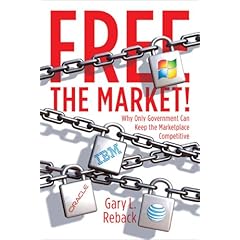
Gary Reback, famed antitrust/IP lawyer and long-time thorn in the side of Microsoft, has written a book entitled “Free The Market!”. The book will be released in mid-April and is available on preorder at Amazon now.
Based on a few excerpts on Reback’s web site it looks like this will be an anecdotal, “in-the-trenches” book (as opposed to theoretical/academic) that should be well worth reading for those interested in the antitrust/IP wars of the last two decades. Reback was truly in the center of most of the big cases during these years, and I hope his book captures the legal issues, strategies and behind-the-scenes events that he witnessed.
This site is hosted by Gesmer Updegrove LLP, a technology law firm based in Boston, Massachusetts. You can find a summary of our services here. To learn how GU can help you, contact: Lee Gesmer


 a huge legal department, and surely some of the lawyers involved in this massive attempt to corral the “Big Six” book publishers and help them raise prices industry-wide had at least a rudimentary knowledge of antitrust law. Any lawyer who takes antitrust in law school, or studies the topic even casually, comes away remembering one thing: price fixing is per se illegal. The law tolerates no excuse.